Butterflies are day-flying insects
of the order Lepidoptera. The order Lepidoptera is the second largest insect order
in Sri Lanka with over 2160 species. At least 195 of them are true Butterflies
and 50 are Skippers, rest being macro and micro Moths. Sri Lanka is home to 245
species of butterflies with 23 of these being endemic to the island.
General Distribution
The majority of species are found
in the foothills up to 3,000 feet elevation. A much smaller number of species
are found above 4,000 feet while 20 species of butterfly are restricted to the
low lying dry zone below 500 feet elevation. A majority of endemic species are
restricted to the wet zone forests. The number of butterflies peaks in two
seasons during the year. The first of these is during the Southwestern monsoon
in the months of March to April. The second is during the Northeastern monsoon
which continues from September to October.
General Threats and
Conservation
Habitat destruction and
degradation, air pollution, over-usage of pesticides, and over-exploitation for
ornamental trade are the main threats to butterflies in Sri Lanka. Prolonged
droughts and over-predation also pose a threat to them. Opportunistic predators
such as ants and birds prey on butterfly eggs, caterpillars, pupae and adult
individuals. The Sri Lankan Rose and Sri Lankan Birdwing species are presently
included in the appendices of the Convention on International Trade in
Endangered Species of Wild Fauna and Flora (CITES). This United Nations
initiative aims to protect these species against over-exploitation by
restricting trade across borders.
1. Sri Lankan Birdwing

Scientific Name – triodes
darsius
Family – Papilionidae
This is the largest butterfly in
the country and also the national butterfly of the island. This is a forest
lover but visits open areas of home gardens where nectar plants and its host
plant Aristolochia (Sap Sanda) grow. It is frequently visible in riparian
forest as well as open scrublands. It is not so uncommon throughout the island
although it is mostly observed in the wet zone. Its large forewings are glossy
black and hind wings bright yellow with a black margin. It has a quite slow
wing beat but the flight is moderately fast as its wings are larger with an
expanse of about 165–175 mm. Its status is listed as Near-Threatened by the IUCN.
2. Sri Lankan Rose
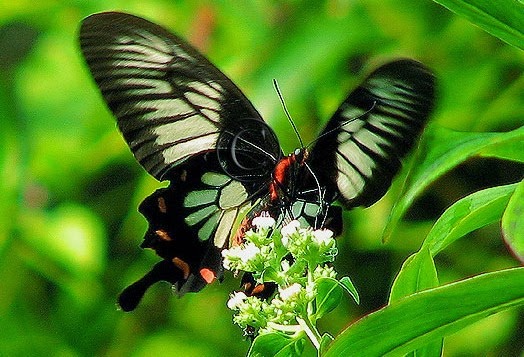
Scientific Name – pacliopta
jophon
Family – Papilionidae
It was earlier classified as a
subspecies of Crimson Rose (Pachliopta hector) but now it is considered endemic
to Sri Lanka. It is confined to the central hill country and is considered a
globally threatened species due to the loss of habitat. The male upperside is
black. The fore wing has three or four broad white streaks in a cell and a
variable number of similar somewhat broader streaks. The hind wing too has
white streaks with crimson lunules irrorated with black scales. The underside
is similar, the markings more distinct and more sharply defined. This is
totally a forest butterfly but visits open areas where nectar plants grow. It
has quite a slow wing beat and the flight is slower compared to other
Pachliopta species. It comes down to feed nectar early morning and late
afternoon. Its status is listed as Critically Threatened by the IUCN.
3. Ceylon Tree Nymph

Scientific Name – idea iasonia
Family – Nymphalidae
The Ceylon Tree Nymph is a
species of nymphalid butterfly in the Danainae subfamily. First described by
John Westwood in 1848, the Ceylon Tree Nymph can be found in both wet and dry
zones of Sri Lanka. It is the largest member of the Danaidae family in the
country with a wingspan of 110–155 mm. Both its wings have similar patterns
which are of a translucent silvery white color. The forewings are almost twice
as long as their width. The female is larger in size than the male, and the
males have narrower forewings than the females. The surface area of The Ceylon
Tree Nymph's wings is relatively large when compared with its weight; this
allows it to fly with little effort and stay aloft for long periods of time.
There are two populations of the
Ceylon Tree Nymph. The smaller and darker colored variety is found in the wet
zone of Sri Lanka from sea level to about 5,000 feet (1,500 m).They usually
inhabit the sub canopies of lowland tropical rain forests. The other variety,
which is larger and lighter colored, is found in the low country dry zone. They
are usually encountered near water courses. Since the Ceylon Tree Nymph requires
very little effort to fly its wing beats are very slow, so slow that the
individual movements of each wing can be easily observed. Most of its time is
spent flying and hovering in the high tree canopies. However, it descends to
ground level to feed and to breed but does not rest on the ground. It usually
rests on the ends of dead branches or twigs. It is listed as Near Threatened by
the IUCN. The main threat faced by the Ceylon Tree Nymph is the destruction of
its habitat. Several of its naturally occurring areas are protected areas, such
as the forest reserve of Sinharaja.
4. Ceylon Tiger

Scientific Name – parantica
taprbana
Family – Nymphalidae
The Ceylon Tiger is also a
species of the Danainae subfamily. It has a wingspan of about 80-90 mm. The
color patterns of sexes are similar. The upper surface of both wings is rich in
dark chocolate brown with bright greenish white markings. The forewings have
two distinct streaks starting at the base of the wings and the hind wing has
similar markings. Both upper wing surfaces have a number of rounded spots
towards the outer margins. The markings on the underside correspond to those on
the upper surface but are lighter in color.
It is restricted to central
mountain forests above 3000 feet on top of Pidurutalagala. It occasionally
strays into the gardens of tea plantations. It is noticeably faster flier than
any other Danaid. It flies commonly near to tree canopy and get nectar on
wayside flowers. It hangs on the flowers at an incline with wings partly open
while feeding. It flies lazily along pathways and roadsides. Not easy to
approach and will fly away albeit slowly at any sudden movement. At very sunny
days this species used to be seen flying slowly about the flowers in parks.
5. Cingalese Bushbrown

Scientific Name – mycalesis rama
Family – Nymphalidae
This satyrid butterfly has a
wingspan of about 56 mm. Its wings are dark brown on the upper side, with two
eyespots at the sub marginal area of the wings. The lower eyespot on the
forewing is prominent and circled with orange, while the others are rather
faint. The underside is dull orange brown, clearly distinguishing it from other
Bushbrowns. It is rare and can be found near bamboo jungles in the low country
wet zone. Their larva feeds on plants of the family Poaceae such as Bamboo. Though
its flight is weak like other Bushbrowns, it flies at a higher level. This
butterfly is extremely shy and will disappear into the undergrowth when
approached. The IUCN lists it as Endangered.
6. Ceylon Treebrown

Scientific Name – lethe
daretis
Family – Nymphalidae
The wingspan of the Treebrown is
about 50-60 mm. There seems to be significant differences between the male and
the female. The male is a medium-sized, mostly dark brown butterfly having a
series of dark sub-marginal spots on the hind wing. The underside is lighter
with more vivid markings. It can be distinguished from all other similar
looking species by the eye-spots on the underside of the hind wing. There are
six eye-spots which are similar in size, shape and color pattern. The eye-spots
are smaller of the male and the yellow band is absent. The female is larger and
less brighter than the male. The undersides are similar in both sexes. The
upper side of the female has a yellow band across the center of the forewing
and a well-defined set of large eye-spots on the hind wing. It has a series of
white streaks that form a diagonal line from the post discal area of the fore wing
and a series of large spots faintly outlined in white on the hind wing.
It is sighted between elevations
of 5,000 and 8,000 feet, but is confined to areas where bamboo grows because
its host plant consists of the Poaceae family. It may often be seen settled on
the ground by the side of forest paths. Though it usually flies away when
disturbed, it does not venture too far away and resettles in the undergrowth
where its camouflage makes it difficult to spot. It is listed as Endangered by
the IUCN.
7. Ceylon Forester

Scientific Name – lethe
dynsate
Family – Nymphalidae
Males are dark brown with the
upper surface of the wings being unmarked except for faint dark eyespots on the
sub marginal areas and tornal areas of the hind wings. Underside is heavily
shaded and the sub marginal area of the wings carry a series of eye spots which
are framed in speckled purple and helps to distinguish the butterfly from the
treebrowns. Females are paler than the male and their underside is similar to
the upper side except they are diffused. They can be found between 800 and 1200
feet where bamboo trees are found. Foresters have a swift flight and stay at a considerable
height, but they also settle occasionally on the ground. It is quite rare and
is listed as Endangered by the IUCN.
8. Blue Oak Leaf

Scientific Name – kallima philarcus
Family – Nymphalidae
Its large size and the unique blue color are
easily distinguishable when compared with other Kallima species. It is leaf
shaped, with the upper side colored in several hues of blue, brown and white.
It has dried up leaf-like patterns on the underside which is completely contrasted
with the upper side. It can adapt its colours to the changing seasons, the dry
season form being somewhat larger and paler. It is not rare but local, from the
sea level to about 2500 feet. It points its head down on a twig, with its tail
in the contact with twig or branch to deliberately give the impression of a
withered leaf hanging in a perfectly natural manner. It is a strong flier but
settles often, while wings wide open towards the sun. They maintain a slow
flapping of wings while basking. When it is been attacked by predators, it
seeks refuge against a tree looking exactly like a withered leaf. At times it
folds its wings and drifts down imitating the falling of a dead leaf. It’s also
known to be fond of rotting fruits. It is listed as Vulnerable by the IUCN.
9.
Jewel Four-ring
Scientific
Name – ypthima singala
Family – Nymphalidae
The wing
span of this butterfly is about 30-45 mm. There is one large eye-spot on the
forewing and a series of smaller ones on the hind wing. Males and females look
quite different on the upper side. This is a much more local butterfly than the
White Four-ring and is confined to the hill tracts of the eastern part of the
island, with some local populations near Kandy in the central hills. Hence it
is less common. It is essentially restricted to grasslands in Uva district
between the elevations of 500 to 5000 feet. It is a butterfly of the dry
grasslands and is rarely seen outside this habitat. Its host plant consists of
grasses belonging to bamboo family. This is a lively little butterfly that
flies all day long among the short grass and herbs in its habitat in large
groups. Its flight is weak and can be considered as a short skip or a bounce
closer to the ground. It moves forward in a zigzag manner with a few crisp wing
beats, often settling at regular intervals to rest nectar. If disturbed, it goes
immediately to ground, trying to hide in low shrubs or thick grass within
security but it does not remain very long. It is one of the first butterflies
to come out in the morning, even in damp conditions and has a tendency to bask
in the early morning with its wings partly open. It is listed as Endangered by
the IUCN.
10.
Ceylon Palmfly

Scientific Name – elymnias singhala
Family – Nymphalidae
Its
wingspan is quite large and is about 60-80 mm. Its wings are dark brown and its
patterns are more refined than the Common Palmfly. The edges of its wings are
rugged with a faint white streak. It is rather shy and usually inhabits dark
dense forests. It often flies as a couple and individual female can be seen
hovering host plants. It has a fondness for over-ripe fruits. It is rare and
can be found near Kandy and other similar elevations. It is listed as
Endangered by the IUCN.
11. Ceylon Hedge Blue

Scientific Name – udara lanka
Family – Lycaenidae
It is a
small family with a wingspan of about 25-30 mm. The upper side of the male
consists of a uniform dark purplish-blue with a faint brownish tinge. The
underside is shining silvery white with faintly marked in spots and lines. The
female is lighter in shade. It is found in the up country and can be sighted in
elevations between 3000 and 6000 feet and commonest between the months of
February and October. It is most frequently encountered in forest foot paths
and clearings and is also found in gardens of bungalows of tea plantations,
though never far from hilly jungle.It likes to bask in the sun. It flies weakly
about low bushes and shrubs and keeps away from tree tops. The males often
settle on damp patches, sometimes in considerable numbers. The females may be
seen at flowers. The IUCN lists it as Endangered.
12.
Ceylon Cerulean
Scientific
Name – jamides coruscans
Family –
Lycaenidae
Like
other butterflies of the Blues Family it is also small with a wingspan of 25-30
mm. It is bluish brown with white markings and a prominent dark spot on the
underside of the wing. Also on the underside are acute ‘v’ markings on the
outer marginal bands. It has a particular liking towards wild flowers for
nectar. It is found up to 500m of the low country in southern parts of Sri
Lanka. This is a forest dwelling species which flies at lower levels of the
forest. When encountered, it is usually in the company of others of its kind.
It is listed as Endangered by the IUCN.
13.
Milky Cerulean

Scientific
Name – jamides lacteata
Family –
Lycaenidae
It is
slightly larger than other Blues Family butterflies with a wingspan of about
32-35 mm. The upper side consists of a pale, shiny, purplish blue. The tail is
black tipped with white. The underside is a pale grayish brown. The female is
quite similar to the male. It is found
up to 500 m of the mid country and can be found throughout the country. It is
extremely active, fluttering around plants for a long time before it settles.
It is also jittery and will take flight when senses any disturbance. Confined
mostly to forests and well wooded areas it usually flies near the ground and
can rarely be seen. It is normally found in rabbles. It is listed as Near
Threatened by the IUCN.
14. Woodhouse's Four Lineblue
Scientific Name – nacaduba ollyeti
Family – Lycaenidae
It has a
wingspan of about 30-32 mm. It has a particular tint of purple blue or deep
purple on the upper sides. It can be distinguished by its similar species from
their more brownish upper surface and the particular metallic gloss. The female can be distinguished because its
upper sides are more blue than purple. They also have a habit of sipping mud. These
butterflies are very rare and can only be found in forested areas in the mid
country. The IUCN has recorded its status as Data Deficient (which is done when
proper studies and research have not been done with regards to the particular
species).
15. Pale Ceylon Six Lineblue

Scientific Name – nacaduba sinhala
Family – Lycaenidae
It has a
wingspan of about 18-28 mm. It is smaller in size than its similar species. Its
colour patterns consist of particular silvery purple tint. It can be
distinguished from its similar species from the three large whitish spots. The
top of its front wings are round and are also transparent. The female can be distinguished with its blue
colour shade and tint and also because its front wings are shade of silvery
white with dark bands. It’s more common
than the other species of Lineblues. These butterflies are mostly found in
forested areas in the wet and intermediate zones. They are migratory and are
also known to sip mud. The IUCN has recorded its status as Data Deficient.
16. Ceylon Indigo Royal
Scientific Name – tajuria arida
Family – Lycaenidae
It has a
wingspan of about 24-26 mm. It is a silvery white butterfly with black spots.
The underside is particular with a prominent black line. The female is similar
to the male. The males of have reduced forelegs, lacking in claws. The antennae
are banded with white. They are sun-lovers and enjoy basking. They tend to fly
in a flitting, irregular manner staying close to the ground. It is found in the
low country wet zone especially in the Haldumulla area. It appears in the new
500 rupee note. It is listed as Critically Threatened by the IUCN.
17. Ormiston’s Oakblue

Scientific Name – arhopala ormistoni
Family – Lycaenidae
It has a
wingspan of about 24-26 mm. The colour patterns of this butterfly are made up
of shades of brown and so it is able to camouflage itself well. The female is entirely brown on the upper
surface. It is extremely rare and can be found in the low country wet zone. The
IUCN has recorded its status as Data Deficient.
18. Green's Silverline

Scientific Name – spindasis greeni
Family – Lycaenidae
They are
small butterflies usually with a wingspan of 20-30mm. The butterflies are
easily recognized by the silvery markings on the underside and the two hind wing
tails. They are very distinct because of their colorful patterns. It has an
extremely rapid flight. It is very rare in Sri Lanka and the IUCN has recorded
its status as Data Deficient (which is done when proper studies and research
have not been done with regards to the particular species).
19. Clouded Silverline

Scientific Name – spindasis nubilus
Family – Lycaenidae
It has a
wingspan of about 24-26 mm. It has a dull indigo blue upper surface and is
distinguishable from the other species by the glowing brick red color on the
underside of the wing. The bands are not so dark and are separated by the black
outlines and heavy silver lining. On its upper side, it has a brilliant shot blue
at its hind wing. The female is similar to the male with the exception of the
shot blue at its hind wing. It is considered as an extremely uncommon butterfly
found in the low country dry zone up to 100m particularly in the North. It has
an extremely rapid flight but settles often, upon which it can be approached
easily. It is listed as Endangered by the IUCN.
20. Lesser Albatross
Scientific
Name - appias galene
Family – Pieridae
It is a
medium sized butterfly with a wingspan of about 50-60 mm. It is a variable
species with distinct wet and dry season forms.
The upper side of it is cream, with a dark band that extends along the
top of the forewings right up to the mid area. The hind wing is entirely yellow.
The female differs from the male as its upper surface has broad dark bands that
cover most of the upper area of the forewing and outer margins of the hind
wing. It is one of the most common butterflies of the intermediate and dry
zones of the island. It inhabits dry evergreen forests and scrub jungle. It is
not found in the hills except during migration.
Usually
they are very active, swarming and has a medium paced flight. They are
sometimes seen resting within the forest shade during peak hours for foraging. It
spends a great deal of time in the canopy of the trees searching for nectar and
visits wild flowers readily but does not find ornamentals attractive. In late
evenings it roosts in large numbers under the canopy of trees, settled on the
upper surface of leaves with their forewings drawn into the hind wings. Both
male and female butterflies are seen mud-sipping during the day time and
sometimes form large swarms in dried up streambeds with a trickle of flowing
water. It is listed as Endangered by the IUCN.
21. One Spot Grass Yellow

Scientific Name – eurema andersonii
Family – Pieridae
Its
wingspan is about 35-40 mm. It is a bright yellow butterfly. There are a few
markings on the underside. It differs from the other Grass Yellows by curved
forewings, which gives it a rounder appearance. There is also a prominent and
uneven, narrow black margin on the border of its wings. On the upper side of
the hind wing there is a single small brownish spot. This species is the least
variable species of Eureme in the country. It is an extremely rare butterfly
which only lives in the wet zone of the island up to elevations of about 3500
feet and is mainly confined to wet evergreen forests.
It is
somewhat gregarious and flies more weakly and hovers close to the ground. It
inhabits forest edges and sunlit areas inside the forests and rarely ventures
out into wide open spaces. Like other species in its family it also loves to
sip mud. It is a species that breeds in forests or close to them, and has only
been sighted at certain times of the year from April periodically to September.
It is listed as Endangered by the IUCN.
22. Black Flat

Scientific Name – celaenorrhinus
spilothyrus
Family – Hesperidae
It has a
wingspan of about 25-35 mm. It is a blackish brown butterfly with tiny white
spots on its forewing. The females are similar to the males but have bigger
white spots as well as small yellow spots on their forewings. The Black Flats
belongs to the Skipper family and are so-called because they tend to skip from
plant to plant. Although they are daytime fliers they are not true butterflies.
The most common visible difference between a Skipper and a true butterfly is
that they have hooks at the end of their antennae. Compared to other
butterflies, Skippers have relatively smaller, elongated wings for their size.
Unlike other butterflies they tend to rest for long periods of time with their wings
opened flat (hence the name Flats). However, when they do fly it is with a lot
of speed, especially in the smaller species.
All over
the island from sea level to 3000 feet elevation, rarer or absent towards the
North. Butterfly seems to prefer wet zone. This is a forest lover but visits
open areas and home gardens where nectar plants grow. They are also frequently
visible in riparian forest and open scrublands at forest edges. It is listed as
Endangered by the IUCN.
23. Decorated Ace

Scientific Name – halpe decorata
Family – Hesperiidae
It has a
wingspan on about 25-35 mm. It is a dirty yellow butterfly with a dark pattern
at the edge of its forewings and another dark pattern in the middle of its
wings. Like the other species in the Skipper family it too tends to skip from
plant to plant. Like a moth the Decorated Ace also has a body which is quite
disproportionate to its wings when compared to the average butterfly. Its body
is also dirty yellow. This butterfly belongs to the sub genus Thoressa or the
ace butterflies together with four other species. They are called ace
butterflies because their shape tends to take a distinct triangular shape. It
is extremely uncommon and is considered as Endangered by the IUCN.


